
Marvell Technology: The Next Trillion-Dollar AI Stock?
6/3/2026

Marvell Technology (NASDAQ: MRVL) just surged more than 25% in a single session after NVIDIA CEO Jensen Huang declared it "the next trillion-dollar company" - but the real story lies in how Marvell's custom silicon, PAM4 optical DSPs, and bold bets on photonic interconnects are quietly becoming the backbone of every major AI data center on Earth.
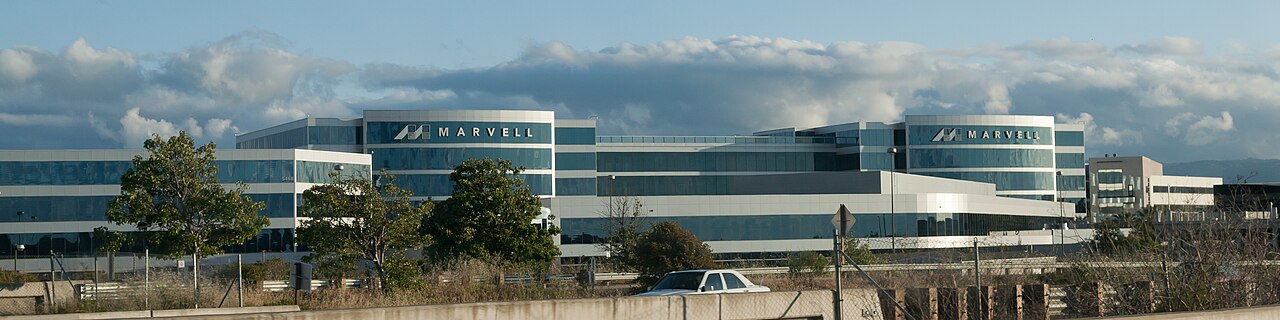
What Is Marvell Technology and Why Is Wall Street Buzzing?
Founded in 1997 by Sehat Sutardja and headquartered in Santa Clara, California, Marvell Technology spent three decades as a semiconductor infrastructure company - quietly building the silicon that moves data across hard drives, Ethernet networks, and carrier lines. For most of its history, that positioned Marvell as a steady mid-cap chip supplier rather than a market darling. That changed the moment AI data centers became the world's most capital-intensive buildout.
In late May 2026, NVIDIA CEO Jensen Huang publicly called Marvell "the next trillion-dollar company" at an industry event, pointing to its unique position inside the AI infrastructure stack. The remark sent MRVL surging more than 25% in a single session, pushing the stock from the $175 range to $281.91 by June 2, 2026. But seasoned investors know that endorsements generate noise. The signal is in the fundamentals - and in Marvell's case, the fundamentals are genuinely exceptional.
Today Marvell operates across three high-growth pillars: custom AI accelerator co-design (XPUs and ASICs), networking silicon (PAM4 DSPs and Ethernet switches), and optical interconnects. All three are expanding simultaneously as hyperscalers pour hundreds of billions into AI infrastructure. CEO Matt Murphy described bookings as "accelerating at a record pace" entering fiscal 2027, and the Q1 earnings print backs that claim with hard numbers.
To understand whether Marvell can actually deliver on Wall Street's trillion-dollar expectations, you need to understand what the company makes, who buys it, and how it compares to rivals like Broadcom and AMD. That is exactly what this article covers - along with a close look at the laser and optical suppliers that ride alongside Marvell in this trade.
Marvell's AI Product Ecosystem: XPUs, Networking, and Optical Silicon
Marvell does not make one chip category - it makes the full suite of silicon that connects, moves, and processes data inside AI data centers. That breadth is a key competitive advantage over pure-play rivals and is why hyperscalers keep deepening their relationship with the company. Here is a breakdown of the three product families driving the AI growth story.
Custom XPU and ASIC Co-Design for Hyperscalers
The highest-value work Marvell does today is co-designing custom AI accelerators - often called XPUs (eXtensible Processing Units) or ASICs (Application-Specific Integrated Circuits) - for cloud giants who want to build their own chips rather than rely exclusively on NVIDIA GPUs. Amazon Web Services (AWS) partnered with Marvell to design Trainium, its custom AI training chip now in volume production for AWS's own workloads and powering Anthropic's training clusters. Microsoft tapped Marvell for silicon IP and back-end design work on its Maia AI accelerator family.
This is not a small side business. XPU-related revenue flows into Marvell's data center segment, which reached 76% of total company revenue in Q1 FY2027. The economics are attractive: Marvell earns engineering fees for the co-design work, then collects recurring revenue as hyperscalers ramp silicon production over multiple product generations. Switching costs are high - once a hyperscaler has co-designed a chip using Marvell's IP, replacing the partner mid-generation requires rebuilding the silicon from scratch, typically a multi-year undertaking.
A key distinction from Broadcom: while Broadcom also does custom AI silicon (Google TPU, Meta MTIA), Marvell's design services go deeper into the physical silicon layer, offering more customization at the cost of lower volume per program. This makes Marvell the right partner for hyperscalers who want highly differentiated, proprietary silicon rather than semi-standard ASIC building blocks.
PAM4 DSP: The Brains Behind Optical Speed
Every time data travels from one GPU to another inside an AI cluster - or from a training cluster to storage - it passes through an optical fiber link. At each end of that fiber is a transceiver module, and at the heart of that transceiver is a digital signal processor (DSP) that encodes and decodes the light signal at extreme speed and precision. Marvell makes those DSPs, and its portfolio is one of the most advanced in the world.
Marvell's PAM4 DSP family - including the Spica, Nova, and newest Ara generations - handles data rates from 400G to 1.6 Tbps per port. The Ara DSP, launched in early 2026, reduces optical module power consumption by 20% while enabling mass adoption of 200 Gbps per lane speeds. That power efficiency is critical: at the scale of a 100,000-GPU cluster, even a 20% power saving on optical links translates to tens of megawatts of reduced infrastructure cost.
Marvell's DSPs are embedded inside transceivers made by Lumentum, Coherent, and other optical module companies. Every transceiver sale by those companies drives demand for Marvell's silicon. This creates a powerful flywheel: as hyperscalers expand AI capacity, they buy more transceivers, which consume more Marvell DSPs, which strengthens Marvell's data center revenue regardless of which GPU or XPU wins the training workload.
Teralynx T100: Marvell's AI-Native Ethernet Switch
Completing the portfolio is the Teralynx T100, Marvell's flagship Ethernet switch chip purpose-built for AI cluster fabrics. Announced in 2026 and entering customer sampling this quarter, the T100 delivers 102.4 Tbps of switching capacity - enough to handle the combined bandwidth of hundreds of high-speed GPU-to-GPU links in a single rack row. Marvell claims 25% lower power versus comparable switches, a critical feature when data centers are already bumping against power grid limits.
The T100 competes directly with Broadcom's Tomahawk and Jericho series, as well as NVIDIA's Spectrum line. Hyperscalers already buying Marvell DSPs for their transceiver modules are logical Teralynx customers as well - giving Marvell an opportunity to deepen its dollar footprint per data center rack. If the T100 wins even a fraction of the AI switch market, it meaningfully diversifies Marvell's revenue beyond XPU co-design alone.
Q1 FY2027 Earnings Deep Dive: A Record Quarter
Marvell's Q1 FY2027 results (the quarter ending May 3, 2026) were the strongest in the company's history across nearly every metric that matters. This was not a one-time beat - it was a beat-and-raise that materially reset analyst expectations for the next two fiscal years. Here is what the numbers actually say.
Revenue, Margins, and Cash Flow
| Metric | Q1 FY2027 | Year-over-Year Change | vs. Estimate |
|---|---|---|---|
| Total Revenue | $2.418B | +28% | Beat |
| Non-GAAP EPS | $0.80 | +29% | $0.01 beat |
| GAAP EPS | $0.04 | - | - |
| Non-GAAP Gross Margin | 58.9% | Expanding | - |
| GAAP Gross Margin | 52.1% | Expanding | - |
| Cash from Operations | $638.8M | Record quarter | - |
| Data Center Revenue (% of total) | 76% | Rising share | - |
Revenue of $2.418 billion was a company record, and the mix continues to shift decisively toward data center. The non-GAAP gross margin of 58.9% is approaching levels typical of software companies - a sign that Marvell's AI products command genuine pricing power. Operating cash flow of $638.8 million in a single quarter provides significant flexibility for continued R&D investment and further acquisitions without diluting shareholders.
GAAP EPS was just $0.04 due to heavy acquisition-related amortization charges stemming from the Inphi, Cavium, Celestial AI, and XConn deals. Investors should focus primarily on the non-GAAP $0.80 figure, which strips out these non-cash charges and better reflects the real economics of the ongoing business. As amortization from earlier acquisitions fades over the next two to three years, GAAP and non-GAAP EPS will converge considerably, which could unlock a new wave of income-oriented buyers.
Guidance Raised: What FY27 and FY28 Targets Signal
Guidance is where Marvell truly moved the needle on sentiment. Management raised the FY2027 revenue outlook to approximately $11.5 billion, implying ~40% growth year over year. More strikingly, Marvell set a FY2028 target of $16.5 billion - implying another ~45% growth year on top of an already record FY27 base. If achieved, Marvell would grow from roughly $6.8 billion in FY2026 to $16.5 billion in two years - a near-tripling of revenue in twenty-four months.
Q2 FY2027 guidance was set at $2.7 billion (representing ~35% year-over-year growth), confirming the momentum seen in Q1 is not a seasonal aberration. For reference, the semiconductor industry typically models 10-15% long-term growth; Marvell is currently running at three to four times that rate across multiple product lines simultaneously.
The key risk embedded in this guidance is execution and concentration: the AI data center buildout must continue at current pace, and Marvell's key hyperscaler relationships must remain intact. Any pause in Amazon or Microsoft AI capex would show up directly in Marvell's numbers. Investors should treat the FY28 $16.5B figure as a target that requires near-perfect conditions, not a guaranteed outcome.
What Is Driving Marvell's AI Data Center Explosion?
Understanding the structural forces behind Marvell's growth matters more than any single earnings print - because it tells you whether the current trajectory is a sustainable multi-year buildout or a peak-cycle wave that will eventually reverse.
Hyperscaler Design Wins: Amazon, Microsoft, and the XPU Race
The primary driver is the hyperscaler custom silicon race. Amazon, Microsoft, Google, and Meta are each spending tens of billions of dollars annually to develop proprietary AI accelerators that are more power-efficient and more customized to their specific workloads than general-purpose NVIDIA GPUs. Marvell is embedded in two of the four largest programs - Amazon Trainium and Microsoft Maia - as the co-design and silicon supply partner.
These relationships are multi-year, multi-generation commitments. AWS's Trainium2 is already in volume production; Trainium3 is understood to be in the design pipeline. Each new generation increases the complexity of the silicon Marvell supplies and pushes revenue per design win higher over time. Management disclosed during the Q1 call that bookings are "accelerating at a record pace" - language suggesting additional design wins beyond publicly announced programs may be in progress.
The strategic logic for hyperscalers is compelling: a custom XPU designed specifically for their workload can deliver 2-3x better performance-per-watt versus a general-purpose GPU for inference tasks. At the scale AWS and Microsoft operate, even a 30% reduction in inference energy costs translates to billions of dollars in annual savings. That ROI justifies years of upfront co-design investment.
NVIDIA's $2 Billion Strategic Partnership
Perhaps the most surprising development of 2026 is that NVIDIA - whose GPU customers partially overlap with Marvell's custom XPU clients - has itself become a strategic investor and partner. NVIDIA committed $2 billion in strategic investment to Marvell and announced the NVLink Fusion program, which allows Marvell-designed custom silicon to interface natively with NVIDIA GPU clusters via the NVLink interconnect standard.
This partnership removes one of the most common bear-case objections against Marvell: that NVIDIA would crowd out Marvell inside hyperscaler AI fabrics. Jensen Huang recognizes that the largest data centers will run heterogeneous AI fabrics - mixing NVIDIA GPUs for general training with custom XPUs for specialized inference workloads. By ensuring Marvell's chips communicate natively with NVIDIA hardware, both companies expand the ecosystem they each serve. Marvell gains access to NVIDIA's customer relationships; NVIDIA gains a co-optimized custom silicon partner for hyperscalers who want differentiated AI accelerators.
Marvell vs. Broadcom vs. AMD: Who Wins the Custom Silicon War?
Marvell is not alone in chasing the custom AI silicon opportunity. Broadcom (NASDAQ: AVGO) is the dominant incumbent with roughly 70% of the custom AI accelerator market, while AMD (NASDAQ: AMD) plays a different angle as a GPU competitor to NVIDIA rather than a pure custom ASIC house. Understanding the differences is essential for investors comparing these names.
| Company | Primary AI Play | Key Customers | Est. ASIC Market Share | Non-GAAP Op. Margin | Revenue Outlook |
|---|---|---|---|---|---|
| Marvell (MRVL) | Custom XPU + PAM4 DSP + Ethernet switch | Amazon, Microsoft, NVIDIA (partner) | ~15% | High 20s - Low 30s% | $11.5B FY27E, $16.5B FY28E |
| Broadcom (AVGO) | Custom XPU + PCIe switches + AI networking | Google, Meta, TikTok parent | ~70% | ~60% | $60-90B AI opp. (FY27, 3 customers) |
| AMD (AMD) | GPU (MI300X/MI400) + CPU (EPYC Venice) | Microsoft Azure, Meta, cloud providers | Not custom ASIC | Mid 20s% | Merchant GPU market, data center segment |
Broadcom is the clear market leader in custom AI silicon and operates at far superior margins (~60% non-GAAP operating margins vs. Marvell's high-20s). Broadcom's Google TPU program alone has been running for multiple generations, giving it a cost-per-die and engineering experience advantage that is difficult to replicate quickly. Broadcom's forward P/E of ~41x reflects that margin dominance and the perceived safety of its entrenched customer programs.
Marvell's investment thesis is different: it is a growth-rate story, not a current margin story. With non-GAAP operating margins in the high 20s today but expanding meaningfully as AI revenue (which carries better gross margins than legacy businesses) grows to over 90% of total sales, Marvell more closely resembles early-stage Broadcom than the mature, highly profitable Broadcom investors see today. Investors accepting more execution risk get more potential upside if Marvell can close the margin gap over the next two to three years.
AMD is a less direct competitor in the custom ASIC space. AMD designs its own GPU architectures and sells them commercially (MI300X, MI400) rather than co-designing proprietary silicon for individual customers. AMD EPYC CPUs (the latest "Venice" generation launched on TSMC's 2nm process in May 2026) compete in the server CPU market rather than displacing Marvell's networking silicon. A hyperscaler choosing Marvell for custom XPUs does not necessarily eliminate AMD GPU purchases - many large data centers run both in the same facility for different workload types.
For guidance on how to evaluate semiconductors using fundamental ratios, read our guides on what is a good P/E ratio by industry and the complete P/E vs EPS vs PEG comparison.
Celestial AI and XConn: Betting Big on Optical Interconnects
Marvell's most aggressive strategic moves of late 2025 and early 2026 were not organic product launches but two acquisitions that together cost over $5.5 billion and signal exactly where CEO Matt Murphy believes the next data center bottleneck is forming: the interconnect layer.
Celestial AI (acquired February 2, 2026, for up to $5.5 billion) is a photonic AI interconnect startup that uses optical computing principles to move data between AI accelerators at the speed of light rather than via conventional copper traces or even traditional fiber. As AI clusters scale beyond 100,000 GPU equivalents, copper interconnects - even at PCIe 6.0 specifications - face fundamental bandwidth and power limits. Optical interconnects sidestep those limits by using photons rather than electrons, enabling dramatically higher bandwidth at lower power across the entire cluster fabric. Marvell's $5.5 billion is a bet that every large-scale AI cluster five years from now will require this technology as standard plumbing.
XConn Technologies (acquired February 10, 2026) brings Compute Express Link (CXL) connectivity expertise. CXL is the emerging industry standard for pooling memory and accelerator resources across server racks, allowing AI training jobs to access far more high-bandwidth memory than any single server can hold. This is critical for training the largest next-generation language models, which require terabytes of memory bandwidth that individual servers cannot provide. With CXL, Marvell can offer data center architects a coherent solution from the accelerator chip all the way to the rack-level interconnect fabric.
These acquisitions add short-term financial headwinds. The $5.5 billion Celestial AI consideration generates significant GAAP amortization that depresses reported EPS for several years - which is why GAAP EPS of $0.04 in Q1 FY27 looks strikingly low versus the non-GAAP $0.80. But the strategic logic follows exactly the same playbook as Marvell's 2021 Inphi acquisition ($10 billion, which looked expensive at the time) - which seeded the PAM4 DSP leadership that now generates hundreds of millions in quarterly data center revenue. The question is whether Celestial AI's photonic technology matures on the three-to-five-year timeline that Marvell's management expects.
Who Supplies Marvell? The Laser and Optical Interconnect Ecosystem
Marvell does not build complete optical transceivers - it designs the DSP silicon that goes inside them. That means a thriving ecosystem of laser and photonics companies directly benefits when Marvell drives adoption of optical interconnects across AI data centers. Investors who believe in the optical thesis but are uncomfortable with Marvell's current valuation should consider these supply chain names as alternative or complementary exposure.
Lumentum (NASDAQ: LITE): Lasers and Optical Circuit Switching
Lumentum is the closest to a direct Marvell partner in the optical supply chain. In March 2026, Marvell and Lumentum jointly demonstrated optical circuit switching (OCS) for next-generation AI scale-up infrastructure. OCS routes optical signals dynamically between GPU racks without converting back to electrical signals, dramatically reducing latency and power consumption in very large AI clusters.
Lumentum's financial trajectory mirrors the AI optical buildout precisely: Q3 FY2026 (ending March 2026) revenue reached a record $808 million, up 90% year over year, driven primarily by transceiver chips and narrow-linewidth laser assemblies, which have now grown for eight consecutive quarters. Management guided ~84.8% revenue growth for the year ending June 2027, with earnings expected to more than double. NVIDIA also committed a $2 billion strategic investment to Lumentum, validating its role as critical photonic supply chain infrastructure. Coherent stock advanced 16% and Lumentum climbed 13% on June 2, 2026 as the optics rally broadened alongside Marvell's earnings surge.
Coherent (NYSE: COHR): Transceivers and Optical Modules
Coherent is the largest pure-play optical component company by revenue and has the deepest transceiver product portfolio running on Marvell's PAM4 DSPs. Where Lumentum focuses more on laser components and optical circuit switching, Coherent produces complete optical transceiver modules - the pluggable units that data center engineers slot directly into switch ports. When hyperscalers upgrade their AI fabric from 400G to 800G to 1.6T speeds (driven by Marvell's Ara DSP ramp), Coherent is the company producing the transceiver modules that house those DSPs.
Coherent received its own $2 billion strategic commitment from NVIDIA, reinforcing that the AI ecosystem actively wants a healthy, well-capitalized transceiver supply chain. Investors considering Coherent as an optical proxy play should note it offers lower single-stock concentration risk than Marvell (because its revenue is diversified across multiple DSP providers, not just Marvell) but also a less differentiated growth driver - it is more commodity-adjacent than Marvell's proprietary silicon.
Acacia (Inside Cisco, NASDAQ: CSCO): Coherent DSPs for Longer-Haul Links
Cisco acquired Acacia Communications in 2021 for $4.5 billion, giving it ownership of a leading coherent optical DSP and module business. Acacia specializes in longer-haul optical links - complementing Marvell's PAM4 DSPs (which handle short reaches up to 10 km inside a campus) with coherent technology for inter-data-center links spanning hundreds of kilometers. As AI training workloads spread across geographically distributed data center campuses, the boundary between "inside the building" (PAM4) and "between buildings" (coherent) is blurring, creating both overlap and partnership opportunity between the two technologies.
Investors wanting pure-play exposure to Acacia's optical capabilities face the complication that it is now embedded inside Cisco's much larger networking revenue - diluting the direct optical AI signal. Cisco as a whole is a more diversified networking play, which may suit investors seeking lower volatility exposure to the optical theme.
| Optical Supplier | Ticker | Role in Marvell Ecosystem | Recent Financial Signal | Key AI Driver |
|---|---|---|---|---|
| Lumentum | LITE | Laser chips; OCS demo partner with MRVL (March 2026) | Q3 FY26 revenue +90% YoY, $808M record | Narrow-linewidth lasers for 800G/1.6T transceivers |
| Coherent | COHR | Optical transceiver modules (house MRVL PAM4 DSPs) | Stock +16% on June 2, 2026 optics rally | 800G and 1.6T transceiver volume ramp for hyperscalers |
| Acacia (Cisco) | CSCO | Coherent DSPs for inter-datacenter optical links | Part of Cisco networking revenue; AI segment growing | Long-haul AI cluster interconnects across campuses |
| Applied Optoelectronics | AAOI | Optical transceivers for hyperscaler networks | Stock +8% on June 2, 2026 optics rally | Hyperscaler transceiver upgrade cycle at 400G to 800G |
The key insight: if you believe the AI optical interconnect thesis is correct but Marvell's post-surge valuation gives you pause, Lumentum and Coherent offer alternative entry points into the same trade at different risk-reward profiles. Neither has the custom XPU exposure that makes Marvell unique, but both benefit from the same data center capex wave and have received direct NVIDIA endorsement in the form of strategic capital commitments.
Use the Finance Halo stock screener to filter optical networking and semiconductor names by sector, market cap, and valuation multiples. For a direct AI-powered analysis of individual names, try MRVL on Finance Halo or compare it to optical peers using the Stock Scores Screener.
Real-World Example: Tracing an AI Request Through Marvell's Silicon
Abstract technology descriptions become concrete when you trace a real workflow through the hardware. Here is what happens when a user submits a complex query to a large language model running on AWS infrastructure - and how many times Marvell silicon appears in that journey.
- The query arrives at an AWS data center and is routed to a Trainium2 AI accelerator cluster - co-designed by Marvell and built on silicon IP Marvell supplied to AWS. The accelerator processes the input tokens.
- The inference job requires data from distributed storage, which travels over a fiber-optic link. At each end of that fiber is a 400G or 800G optical transceiver housing a Marvell Spica or Nova PAM4 DSP chip, converting light pulses to digital data and back at line rate.
- Trainium2 chips communicate with each other across the cluster via NVLink Fusion-compatible interconnects, using Marvell's networking silicon to route inter-chip traffic without bottlenecks.
- Top-of-rack switches aggregate traffic between GPU and accelerator rows - potentially running a Marvell Teralynx T100 chip handling 102.4 Tbps of combined bandwidth across dozens of server uplinks.
- The response travels back through the same fiber and DSP chain, reaching the end user in milliseconds.
In this single inference transaction, Marvell silicon appears at four distinct layers of the stack: the accelerator co-design, the transceiver DSPs, the cluster networking fabric, and the top-of-rack switching. This is the core of the Marvell bull case - it is not a single-product bet on one chip family; it is infrastructure that multiplies across every node in a data center, with each new rack of AI compute adding incremental revenue from multiple Marvell product lines simultaneously.
For a live technical and fundamental analysis of MRVL, including real-time price levels and AI-generated insights, analyze MRVL on Finance Halo's chart and AI assistant. You can also check the Finance Halo Market Intelligence Dashboard for today's AI-generated data center sector outlook.
Is MRVL Stock Overvalued? A Valuation Reality Check
After a 25%-plus single-session surge to $281.91, every investor must honestly ask whether Marvell's stock has already priced in the good news. The short answer: it reflects a very optimistic scenario - but not necessarily an impossible one, given the scale of the revenue ramp management has guided.
Valuation vs. AI Semiconductor Peers
| Company | Ticker | Est. Forward P/E | Revenue Growth (YoY) | Non-GAAP Operating Margin |
|---|---|---|---|---|
| Marvell Technology | MRVL | Premium (high growth, margin expansion story) | ~40% (FY27E guidance) | High 20s to Low 30s% |
| Broadcom | AVGO | ~41x | ~20%+ (AI segment) | ~60% |
| NVIDIA | NVDA | ~32x | ~65% (FY26 reported) | 65%+ |
| TSMC | TSM | ~24x | ~30%+ | ~40% |
Marvell's forward valuation sits between Broadcom and NVIDIA multiples - reflecting a higher revenue growth rate than Broadcom but a significantly lower current margin profile than either NVIDIA or Broadcom. The bull case for owning MRVL at current levels rests on two premises:
- Margin expansion to 40%+ as AI revenue (which commands better gross margins than legacy carrier, enterprise, and consumer businesses) grows to over 90% of total company sales over the next two to three fiscal years.
- Additional undisclosed design wins for XPU programs beyond the publicly announced Amazon and Microsoft engagements - i.e., one or two new hyperscaler wins that the market is not yet pricing in, consistent with management's "record pace" bookings commentary.
The bear case is simpler to state: the FY28 $16.5 billion target requires near-perfect execution for three consecutive years in an industry that is historically cyclical. A single hyperscaler design-win delay - even a one-quarter revenue push - could cause analysts to cut forward estimates, triggering a meaningful re-rating at premium multiples. Investors with a 12-month horizon should be aware that MRVL at current prices has limited margin of safety. Investors with a three-to-five-year view who believe AI infrastructure spending is structurally durable may find the risk-reward profile acceptable given the multi-stack positioning.
To build a complete analytical framework for evaluating growth stocks like MRVL, our guide on how to analyze a stock before buying walks through the key metrics step by step. The Stock Scores Screener on Finance Halo also ranks MRVL and peers on proprietary momentum, breakout, and deep value scores.
Common Mistakes Investors Make When Analyzing Marvell
- Treating MRVL as a pure-play GPU alternative. Marvell does not sell GPUs and does not directly compete with NVIDIA in the AI training market. It is an infrastructure semiconductor company that benefits from AI capex regardless of which GPU or XPU wins any given workload competition. Conflating Marvell with GPU makers leads to incorrect competitive analysis and incorrect sizing assumptions.
- Anchoring on GAAP EPS alone. Marvell's GAAP EPS of $0.04 in Q1 FY27 looks negligible next to the non-GAAP $0.80. The gap is almost entirely acquisition-related amortization - a real but non-cash expense that is directly tied to strategic M&A investments that are generating revenue growth. Investors who focus exclusively on GAAP numbers will consistently underestimate Marvell's underlying earnings power and cash generation capacity.
- Ignoring customer concentration risk. Amazon and Microsoft represent an outsized share of Marvell's data center revenue. A change in either company's custom silicon strategy - a pivot to a different design partner, an internal capability build, or a spending pause - would have outsized revenue impact. Monitor earnings call language around "bookings," "design wins," and "customer diversification" carefully each quarter.
- Assuming optical bets are already proven at scale. The Celestial AI and XConn acquisitions represent large capital commitments to photonic interconnects and CXL memory pooling - technologies that are real and advancing but not yet at mass-market scale inside commercial data centers. These are bets on the 2028-2030 data center architecture, not what hyperscalers need to order in the next quarter. Execution risk on commercialization timelines is real.
- Extrapolating the single-session surge as a new intrinsic value baseline. The 25%+ move following Jensen Huang's comment was driven partly by sentiment, momentum buying, and short covering - not purely by fundamental re-rating. Some portion of that move may retrace. Value the stock based on multi-year free cash flow and revenue projections, not on CEO endorsements or single-session momentum.
- Overlooking the optical supplier ecosystem entirely. If Marvell's optical interconnect vision is correct, Lumentum and Coherent may offer higher near-term revenue certainty at lower valuations for less risk-tolerant investors. A portfolio approach - owning both Marvell and select optical suppliers - provides exposure to the AI data center optical theme across multiple risk profiles and capital allocation tiers.
Frequently Asked Questions
What does Marvell Technology actually make?
Marvell makes semiconductor chips for AI data centers, cloud networks, and telecom infrastructure. Its three core AI product lines are: custom XPU and ASIC chips co-designed with hyperscalers like Amazon and Microsoft; PAM4 DSP chips embedded inside optical transceivers that enable high-speed fiber links between servers; and Ethernet switch chips (Teralynx series) that manage traffic inside AI cluster fabrics. Data center revenue represented 76% of total Q1 FY2027 sales, reflecting how completely Marvell's revenue mix has shifted toward AI infrastructure.
Why did MRVL stock surge more than 25% in one session?
Two catalysts converged simultaneously: NVIDIA CEO Jensen Huang publicly called Marvell "the next trillion-dollar company" at an industry event, and Marvell then reported record Q1 FY2027 results including $2.418 billion in revenue (+28% YoY), non-GAAP EPS of $0.80 (+29% YoY), and raised guidance to $11.5 billion for FY2027 and $16.5 billion for FY2028. The combination of high-profile external endorsement and a genuine earnings beat triggered heavy institutional buying and likely significant short covering that amplified the move.
Is Marvell a competitor to NVIDIA?
Not directly. Marvell's custom XPUs compete with NVIDIA GPUs for certain training workloads at hyperscalers who prefer proprietary silicon, but NVIDIA itself invested $2 billion in Marvell and partnered on NVLink Fusion - enabling Marvell-designed chips to communicate natively with NVIDIA GPU clusters. Most major data centers run NVIDIA GPUs and custom XPUs side by side for different workload types, meaning Marvell and NVIDIA are more complementary than competing in the eyes of the largest hyperscaler customers.
What is the Celestial AI acquisition and why does it matter?
Celestial AI is a photonic interconnect startup that Marvell acquired for up to $5.5 billion in February 2026. Photonic interconnects use light rather than electrons to move data between AI accelerator chips, enabling dramatically higher bandwidth at lower power consumption at the scale of 100,000-plus GPU clusters - a scale where copper interconnects face fundamental physical limits. Marvell's bet is that photonic interconnects become essential infrastructure for every large AI data center by 2028-2030, positioning Marvell to capture that market before competitors can build the technology organically.
Which laser and optical suppliers benefit from Marvell's growth?
Three publicly traded companies are most directly tied to Marvell's optical interconnect strategy: Lumentum (LITE), which makes laser chips and jointly demonstrated optical circuit switching with Marvell in March 2026; Coherent (COHR), which makes the transceiver modules that house Marvell's PAM4 DSP chips; and Acacia (inside Cisco, CSCO), which supplies coherent DSPs for longer-haul data center optical links. Applied Optoelectronics (AAOI) is a smaller beneficiary of the hyperscaler transceiver upgrade cycle. All of these stocks rallied on the same June 2026 AI optics wave that pushed MRVL higher.
How does Marvell compare to Broadcom in custom AI ASIC?
Broadcom dominates with roughly 70% of the custom AI accelerator market, anchored by multi-generation Google TPU and Meta MTIA programs, and operates at ~60% non-GAAP operating margins. Marvell holds approximately 15% market share but has a faster revenue growth rate and a broader product strategy spanning networking silicon and optical interconnects alongside custom XPUs. Broadcom's superior margins (~60% vs. Marvell's high-20s) justify its ~41x forward P/E multiple; Marvell's higher growth rate and margin expansion potential make it a higher-risk, higher-potential-reward alternative for investors who want more upside from the custom silicon theme.
What is the biggest risk for MRVL investors today?
The single largest risk is that Marvell's FY2028 $16.5 billion target requires consistent execution across multiple simultaneous design win programs for three consecutive years. A delay in any major hyperscaler XPU program - Amazon Trainium next generation, Microsoft Maia next generation, or an unannounced third program - would cause analysts to cut forward estimates significantly. Additionally, the Celestial AI photonic interconnect bet must commercialize on schedule; a delay in the optical layer push would remove one of the key forward growth stories embedded in the current valuation.
Can I track Marvell and its optical suppliers on Finance Halo?
Yes. Finance Halo's AI-powered chart pages provide instant access to technicals, fundamentals, and AI-generated analysis for MRVL, LITE, COHR, CSCO, and any other ticker. The stock screener lets you filter semiconductor and communications equipment stocks by sector, market cap, P/E ratio, and other metrics to compare Marvell against its peers. The sector performance page shows real-time sector rotation signals that contextualize where technology and semiconductors fit in the current macro regime.
Conclusion
Marvell Technology stands at a rare inflection point in semiconductor history: a company that spent three decades building network infrastructure silicon and is now positioned at the exact intersection of the world's most powerful investment theme - AI data center infrastructure. Its Q1 FY2027 earnings were not just a strong quarter; they were proof that the multi-year custom silicon design win strategy is converting into real revenue at extraordinary scale, with data center representing 76% of total sales and both FY27 and FY28 guidance raised materially above prior consensus estimates.
The optical interconnect acquisitions - Celestial AI and XConn - show that management is not content to win the current cycle. It is already betting on the next bottleneck, betting $5.5 billion that photonic and CXL interconnects will be as essential to the 2029 data center as PAM4 DSPs are to the 2026 data center. The laser and optical supplier ecosystem - Lumentum, Coherent, Acacia, and Applied Optoelectronics - offers investors alternative or complementary exposure to the same structural theme at different valuations. And the NVIDIA strategic partnership removes the most damaging bear-case objection: that NVIDIA would crowd out Marvell inside hyperscaler AI fabrics.
At $282 per share with the stock having surged over 25% in a single session, Marvell is priced for significant optimism. Investors new to the name should carefully assess their time horizon, understand the customer concentration risk, and size accordingly. For those with a three-to-five-year conviction on structural AI infrastructure spending, Marvell's multi-stack positioning across XPUs, networking silicon, and optical interconnects makes it one of the most intriguing and complete infrastructure plays in the semiconductor sector today.
For more on valuation frameworks useful for analyzing Marvell and its peers, read our guides on what is a good PEG ratio and how to find deep value stocks. For a complete AI-powered fundamental and technical picture of MRVL, visit the Finance Halo MRVL chart page.
Try it yourself: Analyze MRVL with Finance Halo's AI assistant to get instant price targets, technical analysis, and investment insights on Marvell Technology in seconds.
Disclaimer: This article is for educational purposes only and does not constitute investment advice. Always do your own research before making investment decisions.