
Is the AI Trade Cracking? Inside June's Selloff
6/5/2026

The AI trade just had its worst day of 2026. A single guidance number from Broadcom erased hundreds of billions in chip-sector value and reopened the question every investor is whispering: is the AI trade finally cracking, or is this just an overdue reset?

What Happened: Broadcom Lit the Fuse
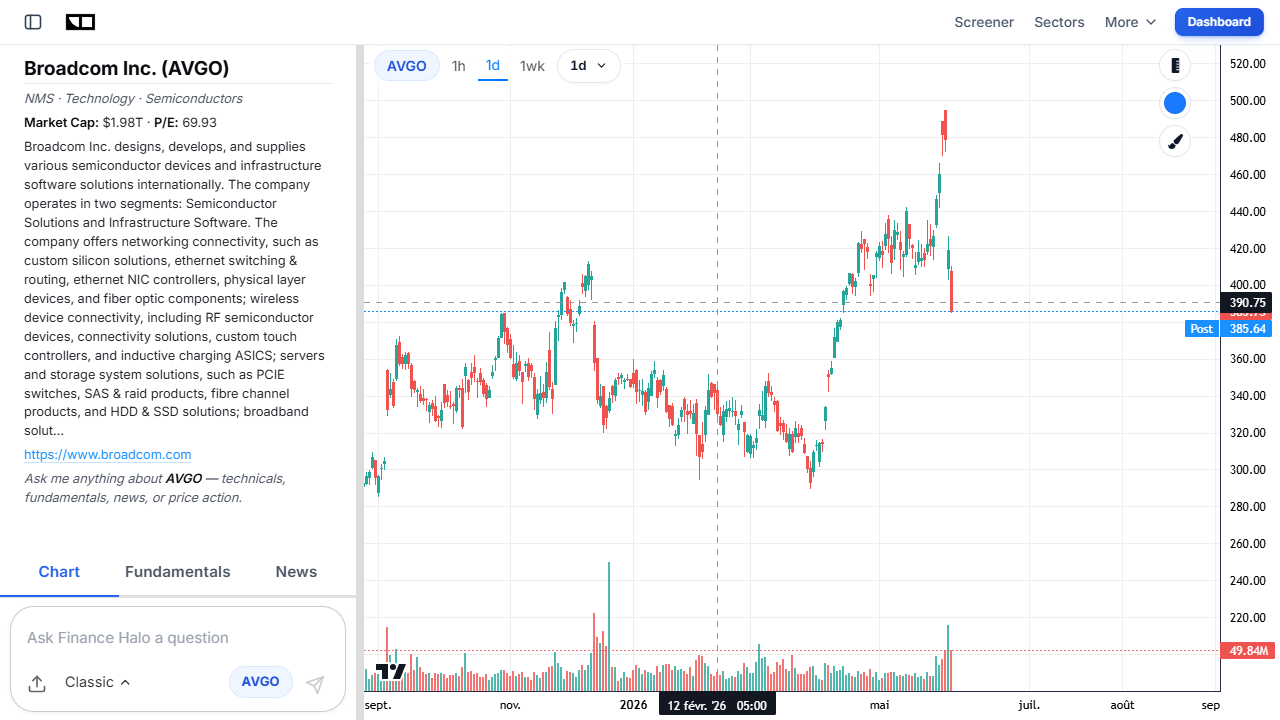
On June 3, 2026, Broadcom (AVGO) reported fiscal second-quarter results that, on paper, looked excellent. Revenue came in at $22.19 billion, up 48% year over year, and adjusted earnings per share of $2.44 beat the $2.40 consensus. The crown jewel, AI semiconductor revenue, more than doubled to $10.8 billion, a 143% jump from a year earlier.
And then the stock fell off a cliff. By Thursday's close, AVGO was down roughly 13-15%, its steepest single-day decline since January 2025, wiping out close to $300 billion in market capitalization in one session. For context, that is more than the entire market value of most companies in the S&P 500, gone in a few hours.
The reason had nothing to do with the quarter that just happened. It was about the quarter ahead, and what management chose not to say.
Strong Results, Soft Guidance: The Perfection Trap
Broadcom guided third-quarter AI chip revenue to roughly $16 billion. Analysts had penciled in somewhere between $16.36 billion and $17.2 billion depending on the desk. The shortfall was small in dollar terms, a few hundred million on a multi-billion-dollar line, but the symbolism was enormous.
Crucially, CEO Hock Tan held the company's full-year AI semiconductor target at $100 billion rather than raising it. In a market that had grown accustomed to AI chipmakers beating and raising every single quarter, simply reaffirming a number felt like a downgrade.
This is what some strategists are calling the AI perfection trap: when a stock is priced for infinite acceleration, maintaining a forecast is treated exactly the same as cutting one. The business did not get worse. The expectations were simply impossible to clear.
Why "good enough" was not good enough
Investors had bid these names up on a specific story: not just growth, but accelerating growth, quarter after quarter, with no end in sight. When the second derivative, the rate of change of the growth rate, even hints at flattening, the math behind a high multiple stops working. We break down how growth assumptions feed into a multiple in our guide to what makes a good PEG ratio.
The "expectations reset" interpretation
The more measured read is that this was an expectations reset, not a broken business. Revenue grew, AI demand stayed strong, and the worry centered entirely on a softer near-term guide. When a stock is priced for perfection, even holding steady can feel like bad news, and the price simply re-rated to a slightly more sober set of assumptions.
How the Selloff Spread Across the Chip Sector
Markets do not treat AI names as isolated stories. They trade as a single theme, so when the bellwether stumbles, the whole complex moves together. Broadcom's drop dragged down nearly every name with AI exposure, and the pain even crossed the Pacific.
| Stock / Index | Reaction during the selloff | Why it moved |
|---|---|---|
| Broadcom (AVGO) | Down ~13-15%; ~$300B market cap erased | Soft Q3 AI guide; FY target held, not raised |
| Micron (MU) | Fell below the $1,000 mark | HBM memory tied directly to AI accelerator demand |
| AMD | Down more than 3% | Highest forward multiple; most sensitive to a reset |
| Intel (INTC) | Down more than 3% | Read-through to broader chip demand |
| Marvell (MRVL) | Sold off with the group | Custom-silicon peer most comparable to AVGO |
| NVIDIA (NVDA) | Down over 1% | Sector leader; relatively cheaper multiple cushioned it |
| KOSPI (South Korea) | Index fell ~7% | SK Hynix and Samsung memory exposure to AI |
The takeaway is uncomfortable for diversification fans: owning ten different AI chip stocks is not ten bets. It is one bet, ten times over. When the narrative cracks, correlation goes to one. You can watch how the whole group moves together on the Finance Halo sector performance dashboard.
Is the AI Trade Actually Cracking?
This is the question that matters, and the honest answer is: it depends what you mean by "cracking." There is a meaningful difference between a fundamental crack (demand evaporates, capex gets cut, revenue forecasts fall) and a valuation reset (demand is fine, but the price paid for that demand was too high).
So far, the evidence points to the second. Broadcom's AI revenue still grew 143%. Hyperscaler capex plans for 2026 are still enormous. What changed is not the business; it is the market's willingness to pay any price for it. That distinction is the entire ballgame.
The bull case
- Demand is real and growing. Bank of America lifted its global semiconductor market forecast to $1.3 trillion for 2026, up from $1.0 trillion just four months earlier.
- Capex is committed. The five largest hyperscalers have already poured over $700 billion into AI infrastructure, and 2026 spending sits near $600 billion.
- Leaders are not stretched. NVIDIA at ~25x forward earnings is not a bubble multiple for a company growing this fast.
The bear case
- Law of large numbers. Tripling revenue is easy at $1 billion and brutal at $100 billion. Deceleration is mathematically inevitable.
- Capex digestion. The market is starting to ask whether $700 billion of spending can actually convert into matching earnings growth, or whether some of it becomes impairment risk.
- Priced for perfection. When AMD trades at 58x forward earnings, there is no margin for a single soft quarter.
The Valuation Problem: What Forward P/E Reveals
Not all AI chip stocks are equally vulnerable, and the forward price-to-earnings ratio is the fastest way to see why. The forward P/E tells you how many dollars you are paying today for one dollar of next year's expected earnings. The higher it is, the more future perfection is already baked into the price.
| Stock | Approx. forward P/E (June 2026) | What it implies |
|---|---|---|
| NVIDIA (NVDA) | ~25x | Surprisingly reasonable for the growth; most defensible |
| Broadcom (AVGO) | ~38x | Premium, but supported by software and AI mix |
| AMD | ~58x | Priced for flawless MI450 execution; least margin for error |
Here is the mechanical reason a high multiple is so fragile. If AMD trades at 58x forward earnings and hyperscaler capex flattens or its MI450 deployments slip, that multiple can compress fast, and the stock can fall hard even if earnings only disappoint slightly. A 25x stock has far less air underneath it.
If you are new to reading these numbers, start with our explainer on what counts as a good P/E ratio by industry, then layer in the growth dimension with the P/E vs EPS vs PEG comparison. For high-growth, not-yet-fully-profitable names, the price-to-sales ratio is also worth a look.
A quick way to sanity-check a multiple
One rough heuristic is to compare the forward P/E to the expected earnings growth rate, which is the logic behind the PEG ratio. A 58x multiple can be justified if earnings are compounding at 50%+ a year, but the moment that growth rate is questioned, the justification disappears. The formula is simple:
A PEG meaningfully above 1 means you are leaning entirely on growth staying elevated. That is exactly the assumption June's selloff put under the microscope.
The $600 Billion Question: Does Capex Convert to Profit?
The deepest worry underneath the selloff is not this quarter's revenue. It is whether the staggering sums being spent on AI hardware will ever generate a proportional return. The five major hyperscalers, Amazon, Alphabet, Meta, Microsoft, and Oracle, have collectively invested more than $700 billion in AI infrastructure over the past couple of years, with 2026 capex near $600 billion.
That spending is the revenue line for the chipmakers. Every dollar of NVIDIA and Broadcom AI sales is a dollar a hyperscaler chose to spend. So the entire chip rally rests on one assumption: that hyperscalers keep writing those checks. The instant the market suspects capex might flatten, every AI supplier re-rates at once.
The bull-bear pivot
The optimistic framing is that 2026 is the year capex finally converts into tangible, monetizable AI products, justifying the spend. The pessimistic framing is that revenue from AI features is not yet keeping pace with the cost of building the infrastructure, which eventually forces a spending slowdown. Broadcom's refusal to raise its target nudged sentiment toward the second story, even if only for a day.
For the macro backdrop on how this spending interacts with rates, sentiment, and sector rotation, the Finance Halo market intelligence dashboard is updated daily.
Concentration Risk: When 7 Stocks Are 35% of the Index
Here is why a chip selloff is not just a chip-investor problem. The Magnificent Seven, the megacap cohort most tied to AI, accounted for roughly 34.8% of the S&P 500 as of May 2026, up from just 12.5% a decade earlier. Add Broadcom and a couple of financials and the top 10 stocks reach nearly 40% of the index.
That means a passive S&P 500 index fund is far more of an AI bet than most investors realize. When the AI complex sneezes, the entire index catches a cold, even though 490 of the 500 companies had nothing to do with Broadcom's guidance.
| Metric | 2016 | 2026 |
|---|---|---|
| Magnificent Seven share of S&P 500 | ~12.5% | ~34.8% |
| Top 10 stocks share of index value | — | ~38-40% |
| Mag 7 share of total index earnings | — | ~31% |
This concentration is why some advisors are steering clients toward equal-weight strategies and away from pure cap-weighted exposure heading into 2026. If you want to understand how an index spreads (or fails to spread) your risk, our breakdown of MSCI World vs the S&P 500 is a useful starting point.
A Crack or a Reset? Lessons From Past AI Pullbacks
This is not the first time the AI trade has had a scare, and the pattern of previous pullbacks is instructive. Each time, the same fear surfaced, "is the bubble bursting?", and each time the answer hinged on whether real demand was still there.
A real-world case study: the expectations-reset playbook
Consider an investor who held NVIDIA through prior single-day drops of 10% or more on hyperscaler earnings jitters. In those episodes, the selloff was driven by sentiment and positioning, not by a collapse in orders. Buyers who used the panic to add, while demand metrics stayed intact, were generally rewarded as the names recovered once the "perfection" math reset to something achievable.
The lesson is not "always buy the dip." It is "diagnose the dip." The questions to answer before acting:
- Did demand actually fall, or did the stock just miss an inflated bar? Broadcom's 143% AI growth answers this clearly: demand did not fall.
- Did management cut guidance, or merely fail to raise it? Reaffirming is very different from slashing.
- Is the multiple still extreme after the drop? A 58x stock that falls to 50x is still expensive; a 25x stock that falls to 21x may be a gift.
By that scorecard, June 2026 reads far more like a reset than a crack, but a reset that shifts the burden of proof onto the bulls.
How to Position: A Framework for the AI Selloff
You do not need to predict the next tick to act intelligently. You need a framework that survives both outcomes, crack or reset. Here is a practical one.
1. Separate the leaders from the lottery tickets
Rank your AI exposure by valuation cushion. A name at ~25x forward earnings with real cash flow is a fundamentally different risk than a 58x name priced for flawless execution. Use the Finance Halo market screener to filter by P/E range and market cap so you can see, at a glance, which of your holdings have the least margin for error.
2. Size positions for correlation, not count
Remember that ten AI chip stocks behave like one position in a selloff. Size the theme, not the individual tickers. If AI is 40% of your portfolio across "different" names, you are far less diversified than the ticker count suggests.
3. Use a rules-based entry, not emotion
Decide in advance what would make you a buyer: a specific multiple, a confirmed demand data point, or a technical level. Pairing valuation with technical confirmation, the approach in our guide on combining RSI, MACD, and moving averages, helps you avoid catching a falling knife.
4. Average in instead of timing the bottom
Nobody rings a bell at the low. Spreading purchases over time reduces the cost of being early, which is the entire premise behind dollar-cost averaging versus lump-sum investing.
5. Keep dry powder
If the AI trade really is resetting to lower multiples, the best opportunities come to those with cash to deploy. A selloff is only a gift if you can afford to take it.
Common Mistakes Investors Make in a Selloff
- Confusing a guidance miss with a demand collapse. Fix: read the actual revenue and growth numbers before reacting to the price. Broadcom grew AI 143%; the stock fell on optics.
- Assuming "diversified" because you own many AI names. Fix: measure your total thematic exposure, not your ticker count. Correlation goes to one in a selloff.
- Buying the highest-multiple name because it fell the most. Fix: a 58x stock down 10% is still 52x. The biggest drop is not the biggest bargain.
- Trying to catch the exact bottom. Fix: average in with a rules-based plan instead of betting on a single entry.
- Ignoring index concentration. Fix: recognize that a plain S&P 500 fund is already a heavy AI bet; do not double down unknowingly.
- Letting one red day rewrite your entire thesis. Fix: revisit the fundamentals that made you buy. If they are intact, a price move is noise, not news.
Frequently Asked Questions
Is the AI trade cracking or just resetting?
Based on the June 2026 evidence, it looks far more like a valuation reset than a fundamental crack. Broadcom's AI revenue still grew 143% year over year, and hyperscaler capex remains near $600 billion. What changed was the market's willingness to pay extreme multiples, not the underlying demand for AI chips.
Why did Broadcom stock crash if earnings beat estimates?
Broadcom fell roughly 13-15% because its Q3 AI chip guidance of about $16 billion missed analyst expectations, and management held its full-year $100 billion AI target steady instead of raising it. When a stock is priced for accelerating growth, simply meeting or maintaining a forecast is treated like a disappointment.
Which AI chip stock is most at risk in a selloff?
On valuation alone, the highest-multiple names carry the most downside risk in a reset. AMD traded near 58x forward earnings in June 2026, versus roughly 38x for Broadcom and 25x for NVIDIA, so AMD has the least cushion if growth expectations are trimmed.
Does a chip selloff affect the whole stock market?
Yes, more than most investors expect. The Magnificent Seven make up around 35% of the S&P 500, so a sharp move in AI megacaps drags the entire index, even though the vast majority of its 500 companies are unrelated to AI chips.
Should I buy the dip in AI stocks?
Only after diagnosing it. Ask whether demand actually fell or the stock merely missed an inflated bar, whether guidance was cut or just not raised, and whether the multiple is still extreme after the drop. If demand is intact and the valuation is reasonable, dips have historically been buying opportunities, but this is not investment advice.
What is the AI "perfection trap"?
It describes a stock priced so aggressively for accelerating growth that maintaining a forecast is punished as severely as cutting it. Because all the good news is already in the price, only an upside surprise can keep the stock rising, leaving no room for a merely good quarter.
How can I tell if an AI stock is overvalued?
Start with the forward P/E and compare it to the company's expected earnings growth rate (the PEG ratio). A multiple far above the growth rate means you are paying up for perfection. You can screen and compare these metrics across stocks using the Finance Halo market screener.
Conclusion
So, is the AI trade cracking? The most defensible answer after June 2026 is: not yet, but the rules have changed. Broadcom's selloff was an expectations reset, triggered by a soft guide rather than a demand collapse, on a business still growing AI revenue 143%. The fundamentals that built the rally, $600 billion in hyperscaler capex and a $1.3 trillion chip market, remain intact.
What shifted is the market's tolerance for paying any price. With the Magnificent Seven at roughly 35% of the S&P 500 and names like AMD priced at 58x forward earnings, the AI trade no longer gets the benefit of the doubt. The burden of proof has moved from the skeptics to the believers. That is healthy, not catastrophic, but it means discipline now beats momentum. Separate the reasonably-valued leaders from the priced-for-perfection lottery tickets, size your exposure by correlation rather than ticker count, and keep dry powder for the dips you can actually diagnose.
Try it yourself: Analyze Broadcom (AVGO) with Finance Halo's AI assistant to get instant valuation context, technical levels, and a read on whether the selloff is a crack or a buying opportunity.
Disclaimer: This article is for educational purposes only and does not constitute investment advice. Always do your own research before making investment decisions.