
Alphabet's $80B Share Sale: Dilution Risk or AI Bet?
6/4/2026

On June 1, 2026, Alphabet announced the largest equity raise in its history - an $80 billion share sale to fund its AI infrastructure buildout. The stock dropped 4% the next morning. Is dilution the real story, or is this a bet investors should be backing?

What Happened? Alphabet's Record $80B+ Capital Raise
On June 1, 2026, Alphabet Inc. (GOOGL) dropped a bombshell announcement that rattled markets: the company plans to raise more than $80 billion in new equity capital - its first stock issuance since the Google IPO in 2004, more than two decades ago. The offering was subsequently upsized to $84.75 billion before it officially launched.
The structure of the raise has three distinct components, each targeting a different pool of capital:
- $10 billion private placement to Berkshire Hathaway - $5B in Class A Common Stock at $351.81/share and $5B in Class C Capital Stock at $348.20/share, negotiated directly with Warren Buffett's firm.
- $30 billion underwritten public offerings - split between $15B in mandatory convertible preferred stock and $15B in common Class A and Class C shares, underwritten by major investment banks.
- $40 billion at-the-market (ATM) program - to begin in Q3 2026, allowing Alphabet to sell shares gradually into the open market over an extended period.
The announcement came one week after Alphabet reported blowout Q1 2026 results, making it one of the most closely watched corporate finance events of 2026. The stock closed at $372.58 the day of the announcement, then opened down 3.47% the next morning as investors weighed the dilution implications.
Why the timing matters
Alphabet's decision to raise equity rather than debt is notable. The company carries a pristine balance sheet with tens of billions in net cash. CEO Sundar Pichai and CFO Anat Ashkenazi chose equity specifically because the scale of planned investment - $180 to $190 billion in 2026 capex alone - is so large that even Alphabet's $30-40 billion in annual free cash flow would leave a significant funding gap without either taking on massive debt or slowing buybacks.
The historical context
To appreciate how extraordinary this is: Alphabet went from its 2004 IPO through 22 years of sustained growth without issuing a single share to the public markets. The company funded its expansion - from a search engine to a global cloud, AI, and advertising empire - entirely through internal cash generation and occasional debt. The decision to break that streak signals something fundamental: the AI infrastructure arms race has reached a scale where even the most cash-generative company on the planet needs external capital.
Why Does Alphabet Need $80 Billion?
The one-word answer is AI. The fuller answer is that Alphabet's AI infrastructure demand is outpacing its supply, and closing that gap requires capital commitments that would stretch even its formidable cash generation.
The 2026 capex plan
Alphabet updated its 2026 capital expenditure guidance to $180 to $190 billion - nearly double its 2025 spend of $91.4 billion, which was itself nearly double the $52.5 billion it spent in 2024. The capex breaks down roughly as:
| Category | Share of Capex | What It Funds |
|---|---|---|
| Servers and AI compute | ~60% | AI accelerators (GPUs, TPUs), networking chips, HBM memory |
| Data centers | ~40% | Buildings, power infrastructure, cooling, land acquisition |
At $185 billion (midpoint), Alphabet's 2026 capex alone is larger than the GDP of many countries. The company's trailing twelve-month free cash flow runs at approximately $70-80 billion - substantial, but only enough to fund roughly 40% of the planned spend. The equity raise bridges that gap without loading the balance sheet with debt that could constrain financial flexibility if AI demand softens.
AI demand is outpacing supply
Alphabet was direct in its June announcement: customer demand for its AI solutions and services from enterprises and consumers is "exceeding the company's available supply." This is not a speculative bet on future demand - it is a response to an actual supply constraint. Google Cloud grew 63% year-over-year to $20 billion in Q1 2026 alone. Every dollar of incremental cloud capacity that Alphabet can bring online has a paying customer waiting for it.
DeepMind's compute hunger
A second driver is Google DeepMind. The company has consolidated its AI research under DeepMind and is training models at scales that require purpose-built compute clusters. Unlike cloud revenue (which is commercial), DeepMind compute is an internal cost - but one that directly feeds into product improvements across Search, YouTube, Gmail, Maps, and Workspace that in turn defend Alphabet's core advertising franchise.
How Does Share Dilution Actually Work?
Before assessing whether Alphabet's dilution is dangerous, it helps to understand the mechanics clearly. Share dilution occurs when a company issues new shares, increasing the total count of shares outstanding. Each existing shareholder now owns a smaller percentage of the company.
The EPS impact formula
The most direct financial impact is on earnings per share (EPS). The formula is straightforward:
If net income stays constant but shares outstanding increases by 2%, EPS falls by roughly 2%. For a company like Alphabet that trades at a price-to-earnings multiple, a lower EPS means a lower fair value at the same multiple - all else equal.
A simple dilution example
Consider a simple hypothetical. A company has 1,000 shares outstanding and earns $10,000 in net income. Its EPS is $10.00. If it issues 20 new shares (2% dilution) and net income stays flat, EPS falls to $10,000 / 1,020 = $9.80 - a 2% decline. At a 25x P/E multiple, the stock's fair value drops from $250 to $245.
But this is the static view. The dynamic view asks: what does the company do with the proceeds? If those 20 new shares raise enough capital to generate $1,000 in additional net income, EPS actually rises to $10.78 - more than recovering the dilution. This is the bull case for any capital raise: returns on the new investment exceed the dilution cost.
For a more detailed look at how EPS and earnings metrics work together, see our guide to P/E, EPS, and PEG ratios.
Not all dilution is equal
Context matters enormously. Dilution is clearly harmful when:
- Shares are issued at prices far below intrinsic value
- Proceeds fund low-return or speculative activities
- The company has no clear path to recovering the EPS drag
Dilution is potentially value-creating when shares are issued near fair value and proceeds fund investments with returns above the company's weighted average cost of capital (WACC). Alphabet's situation needs to be evaluated against these criteria.
Is the Dilution Risk Real for GOOGL Shareholders?
Let's run the actual numbers for Alphabet.
Calculating the dilution percentage
Alphabet had approximately 12.3 billion shares outstanding as of Q1 2026 (combined Class A, B, and C). At an average issuance price of roughly $360 per share, $80 billion in new shares implies approximately:
A 1.77% dilution is the headline figure. It is real, but it is also modest - particularly for a company with Alphabet's growth trajectory.
The buyback offset
Here is the critical context that most of the bearish coverage omitted: Alphabet repurchased $62 billion in stock in 2025 and another $15 billion in Q1 2026 alone. At a $360 per share price, $62 billion per year buys back approximately 172 million shares annually.
That means Alphabet's annual buyback program retires approximately 172M shares per year, while the new issuance adds approximately 222M shares. The net dilution - assuming buybacks continue at the 2025 pace - is only about 50 million shares, or roughly 0.4% of shares outstanding. At the current buyback pace, the entire $80B raise is offset within roughly 15 months of repurchases.
| Metric | Value |
|---|---|
| Shares outstanding (Q1 2026) | ~12.3 billion |
| New shares from $80B raise (at ~$360) | ~222 million |
| Gross dilution | ~1.77% |
| Annual buyback (2025 pace) | ~172 million shares/year |
| Net dilution (annualized) | ~50 million shares (~0.4%) |
| Time to offset via buybacks | ~15 months |
The real question: return on invested capital
The dilution math is manageable. The harder question is whether the capital deployed earns a sufficient return. Google Cloud's 63% growth at $20B quarterly revenue suggests the business has significant operating leverage. If Alphabet can grow cloud revenue from $80B annually (2026 run rate) to $150-200B by 2028-2029, the returns on $185B of 2026 capex look very attractive. If cloud demand stalls or competition intensifies, the capex overhang becomes a drag. This is the genuine risk - not a 1.8% dilution.
To learn how to assess these risks before investing, see our guide on how to analyze a stock before buying.
Berkshire Hathaway's $10B Vote of Confidence
Perhaps the most significant aspect of the June 1 announcement was not the size of the raise but who anchored it. Berkshire Hathaway committed $10 billion in a private placement - one of Warren Buffett's largest single investments in a technology company and the largest Berkshire tech commitment since Apple.
What the deal terms reveal
Berkshire's private placement was at $351.81 per share (Class A) and $348.20 per share (Class C) - a modest discount to market prices at the time of announcement. This is standard for large private placements, but it also means Berkshire effectively required very little "friend discount" to make the investment. The firm had already been building a position in Alphabet since Q3 2025, with a stake worth approximately $20 billion prior to this deal. Adding $10 billion brings Berkshire's total exposure to roughly $30 billion - comparable in scale to its long-standing Apple position.
Why Buffett's endorsement matters
Berkshire's investment philosophy is famously conservative and focused on businesses with durable competitive advantages, strong free cash flow, and rational capital allocation. The $10B commitment signals that Buffett views Alphabet's AI infrastructure spending as disciplined capital allocation - not wasteful empire building. For retail investors uncertain about the dilution, Berkshire's co-investment provides an important data point about how sophisticated long-term investors view the risk/reward.
That said, Buffett has made mistakes before (most notably avoiding technology for decades, then overpaying for IBM). The Berkshire halo is evidence, not proof. But it meaningfully shifts the probability-weighted assessment.
How Does GOOGL's AI Capex Compare to Rivals?
Alphabet is not alone in making massive AI infrastructure bets. Every major cloud hyperscaler has announced record capital expenditure plans for 2026. The combined capex of the four largest cloud/tech companies in 2026 is expected to reach approximately $725 billion - a 77% increase from 2025 and the largest single-year technology infrastructure buildout in history.
| Company | 2026 Capex Guidance | Primary AI Focus |
|---|---|---|
| Amazon (AMZN) | ~$200 billion | AWS data center expansion, AI inference |
| Microsoft (MSFT) | ~$190 billion | Azure AI, OpenAI partnership infrastructure |
| Alphabet (GOOGL) | $180-190 billion | Google Cloud, DeepMind, AI compute |
| Meta Platforms (META) | ~$135 billion | Llama models, social AI, Reality Labs |
In this context, Alphabet's decision to raise equity rather than rely solely on debt or free cash flow can be seen as conservative capital management. Amazon and Microsoft have both taken on additional debt to fund their capex plans. Alphabet chose to dilute shareholders by 1.8% rather than lever up its balance sheet - a trade-off that preserves financial flexibility if the AI buildout takes longer to monetize than expected.
Is the capex arms race rational?
Analysts are split. The bull case: AI compute capacity will be the scarce resource of the next decade, and companies that own the infrastructure will extract enormous economic rents from businesses that need it. The bear case: capex cycles in tech have historically ended badly (the 1990s telecom fiber overbuild is the canonical example), and the current surge risks creating excess capacity that crushes returns. The $725 billion question is which scenario plays out - and the answer won't be clear for 2-3 years.
Alphabet's Financial Firepower: Can It Afford This?
Even before the equity raise, Alphabet's financial position was exceptional. The company entered 2026 as one of the most profitable businesses on earth, with the cash generation to support large-scale investment.
Q1 2026 earnings highlights
- Total revenue: $109.9 billion (+22% YoY) - 11th consecutive quarter of double-digit growth
- Google Services revenue: $89.6 billion (+16%), driven by Search (+19%) and YouTube ads (+11%)
- Google Cloud revenue: $20.0 billion (+63%), the fastest-growing major cloud division globally
- Operating income: +30% YoY; operating margin expanded to 36.1%
- Net income: +81% YoY
- EPS: $5.11 (+82% YoY)
These are not the metrics of a company in distress. Alphabet is raising equity from a position of strength, not weakness. That distinction matters enormously when evaluating dilution risk. A financially weak company issuing shares is diluting existing holders to stay alive; a financially strong company issuing shares is choosing equity over debt because the long-term math is favorable.
The valuation context
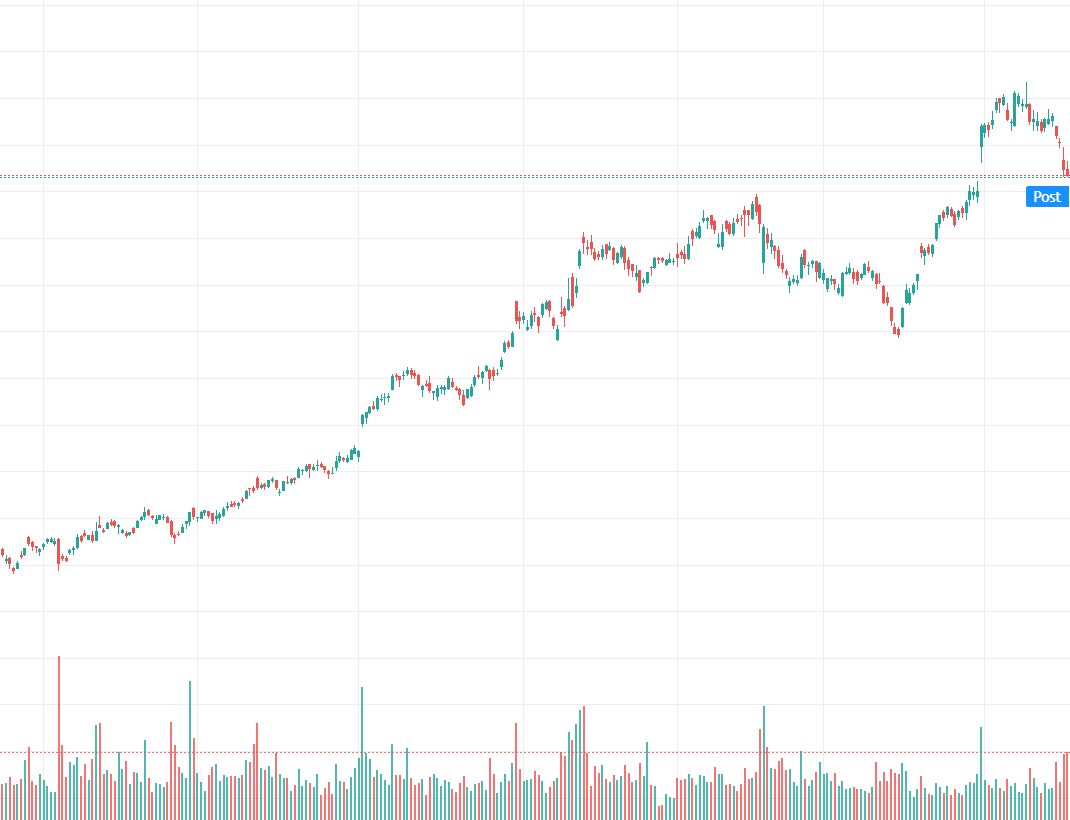
At $357-372/share (post-announcement range), Alphabet traded at approximately 29.4x trailing P/E - as shown on Finance Halo's chart page below. For a company growing EPS at 82% year-over-year, that multiple is arguably modest. The PEG ratio - which divides P/E by the earnings growth rate - implies GOOGL is trading at a PEG below 0.5 based on Q1 2026 growth rates, well below the 1.0 threshold typically considered fair value.
Of course, 82% EPS growth is partly a function of a low 2025 base. Sustainable growth will normalize lower. But even at a 20-25% long-term EPS growth rate, a 29x P/E represents a reasonable - if not cheap - entry point for a business of this quality. Use the Finance Halo stock screener to compare GOOGL's valuation metrics against its peer group.
GOOGL Stock Reaction: What the 4% Drop Really Tells Us
The market's initial reaction - a 3.5-4% drop - was predictable but arguably excessive. Investors hate dilution as a reflex; the immediate price action reflected that reflex rather than a careful analysis of the dilution magnitude or the purpose of the raise.
Why the market overreacted
Several factors contributed to the sell-off:
- Surprise factor: Alphabet had not issued equity in 22 years. The announcement caught investors off guard and triggered an emotional response.
- The ATM program creates overhang: The $40B at-the-market program means Alphabet can sell shares into the open market throughout Q3 and beyond. This creates what traders call "supply overhang" - a persistent ceiling on the stock as sellers know more shares can come any time.
- Bearish retail sentiment: Stocktwits and retail investor forums quickly turned bearish, amplifying the initial decline through momentum selling.
Why the sell-off is likely a short-term event
The longer-term view is more constructive. A 4% drop on a 1.8% dilution implies the market was pricing in permanent EPS destruction - but as shown above, Alphabet's buyback program will offset the dilution within 15 months. More importantly, if the AI infrastructure investment generates even modest incremental returns, EPS growth will accelerate rather than decelerate in 2027-2028.
Historical precedent also favors the patient investor. Major capital raises by quality companies at reasonable valuations have consistently proven to be buying opportunities when the underlying business continues to grow. The $80B raise is large in absolute terms but small relative to Alphabet's $4.67 trillion market capitalization - approximately 1.7% of market cap.
Real-World Example: Running the Dilution Math on GOOGL
Let's walk through a complete forward-looking scenario to illustrate whether this raise creates or destroys value for shareholders.
The scenario setup
Assume the following:
- Alphabet's net income for full-year 2026 is $105 billion (roughly annualizing Q1's $5.11 EPS at ~12.3B shares)
- The $80B raise adds ~222M shares at ~$360/share
- Alphabet continues buying back $62B/year in stock (~172M shares)
- The AI infrastructure investment drives an incremental $15B in net income by 2028 (via Google Cloud margin expansion)
Scenario A: No return on investment (bear case)
If the $180-190B in 2026 capex earns no incremental return, shares outstanding increase by ~222M while net income stays flat. EPS drops from approximately $8.54 to $8.35 - a 2.2% decline. At a 28x P/E, stock fair value falls from ~$239 to ~$234. This is the worst-case outcome, and it assumes the AI investment generates zero return - an extreme and unlikely scenario given the existing demand backlog.
Scenario B: Modest ROI (base case)
If the AI investment drives 15% incremental revenue growth in Cloud by 2028, Alphabet's net income grows to approximately $125B. After accounting for the diluted share count (post-raise ~12.52B shares minus buybacks over 2 years ~344M = ~12.18B net), EPS reaches approximately $10.26. At the same 28x P/E, fair value rises to approximately $287 per share - a meaningful increase from the post-announcement $357.
Wait - that seems low. At a 30-32x P/E on $10.26 EPS, fair value would be $308-328. The key insight: the dilution is already priced in after the 4% drop, and any incremental return on the AI investment creates upside.
Scenario C: Strong ROI (bull case)
If Google Cloud revenue doubles to $160B annually by 2028, and operating margins continue to expand toward 40%, net income could approach $145-155B. On approximately 12B shares (post-buybacks), EPS of $12.00-13.00 at a 30x multiple implies a stock price of $360-390 - back near the pre-announcement highs, with the dilution fully absorbed.
This is why the question "dilution risk or AI bet?" doesn't have a single answer. Both are true simultaneously: there IS dilution risk (Scenario A), but if Alphabet's track record of capital allocation holds, the AI bet is the more likely outcome.
Common Mistakes Investors Make When Evaluating Share Sales
- Mistake 1: Treating dilution as always bad. Dilution is only harmful if the capital raises less return than it costs. Alphabet buying back $62B/year while raising $80B is an explicit statement that the AI investment opportunity exceeds the return of buying back its own shares - a high hurdle for a company whose stock has historically compounded at 20%+ per year.
- Mistake 2: Ignoring the offset from buybacks. Most retail investors seeing "$80B share issuance" do not think about the $62B per year being simultaneously retired. Net dilution is far smaller than gross dilution. Always calculate the net change in shares outstanding, not the gross issuance.
- Mistake 3: Panicking on the initial price drop. The 4% decline reflected emotional selling, not a fundamental reassessment of Alphabet's long-term earnings power. History shows that major capital raises by profitable companies with clear investment thesis are rarely permanent valuation events.
- Mistake 4: Comparing the wrong numbers. $80B sounds enormous until you compare it to Alphabet's $4.67 trillion market cap (1.7%), its $110B quarterly revenue run rate, or the $725B being collectively spent by its peers. Context always matters.
- Mistake 5: Conflating capital raising with financial distress. Companies issue equity for very different reasons. A startup issuing shares to survive is dilutive and dangerous. A cash-generating mega-cap issuing shares to invest in a structural growth opportunity is a completely different category.
- Mistake 6: Ignoring the capital structure implications. By raising equity instead of debt, Alphabet preserves balance sheet flexibility. If the AI investment cycle peaks in 2027-2028 and capex needs to be cut quickly, no bond covenants constrain management's options. Debt is cheaper in the short run; equity preserves optionality.
For a broader framework on how to evaluate these kinds of decisions, our guide on finding deep value stocks covers how to think about capital allocation when assessing long-term investment quality.
Frequently Asked Questions
How much dilution will Alphabet's $80B share sale cause?
At approximately $360/share average, the $80B raise implies roughly 222 million new shares - about a 1.77% increase in Alphabet's ~12.3 billion shares outstanding. However, Alphabet's $62B annual buyback program retires ~172 million shares per year, meaning the net dilution at the current buyback pace is approximately 50 million shares (0.4%) per year, offset within about 15 months of ongoing repurchases.
Why did GOOGL stock drop 4% after the announcement?
The initial sell-off reflected a combination of surprise (Alphabet had not issued equity since 2004), concern about dilution, and the announcement of a $40 billion at-the-market program that creates a persistent supply overhang. The market's reaction was largely reflexive rather than analytical - the actual dilution magnitude (~1.8%) does not justify a 4% permanent decline for a company growing EPS at 82% year-over-year.
What will Alphabet do with the $80 billion raised?
The proceeds fund Alphabet's 2026 capital expenditure plan of $180-190 billion, primarily directed at AI compute infrastructure: servers (including AI accelerators), networking equipment, and data center construction. The company explicitly stated that enterprise and consumer demand for its AI services is exceeding available supply - the capital bridges that gap.
Why did Berkshire Hathaway invest $10 billion in Alphabet?
Berkshire participated in a private placement at $351.81/share (Class A) and $348.20/share (Class C) - a modest discount to market. Berkshire had been building its Alphabet position since Q3 2025, reaching approximately $20 billion before this deal. The additional $10B commitment indicates that Buffett's firm views Alphabet's AI infrastructure investment as rational capital allocation by a business with durable competitive advantages and strong free cash flow generation.
Is Alphabet issuing shares because it needs money?
No. Alphabet entered 2026 with a pristine balance sheet and generates $70-80 billion in annual free cash flow. The equity raise is a strategic capital structure decision - using equity rather than debt to preserve financial flexibility, while funding infrastructure investment at a scale that exceeds even Alphabet's exceptional internal cash generation. The company's Q1 2026 EPS grew 82% year-over-year, which is not consistent with financial distress.
How does GOOGL's AI capex compare to competitors?
Alphabet, Microsoft, Amazon, and Meta are collectively spending approximately $725 billion on AI infrastructure in 2026 - a 77% increase from 2025. Alphabet's $180-190B is broadly in line with Microsoft's $190B and slightly below Amazon's $200B. The scale underscores that this is an industry-wide infrastructure moment, not an Alphabet-specific aggressive bet.
What is the risk that the AI investment does not generate returns?
This is the genuine risk - not dilution. If cloud demand softens, model development reaches a plateau, or competition from Microsoft's Azure and AWS intensifies more than expected, $185B in annual capex creates a significant cost burden without commensurate revenue. The 1990s telecom overbuild - where fiber capacity far exceeded demand for years - is the historical cautionary tale. However, unlike the 1990s (which was speculative), Alphabet is investing in response to a documented demand shortfall, which is a materially different risk profile.
Should I buy GOOGL after the 4% drop?
This article is educational and not investment advice. That said, the analytical framework suggests the 4% post-announcement drop was an overreaction to a 1.8% dilution event for a company growing EPS at 82%. The key variable to monitor is Google Cloud revenue growth in Q2-Q3 2026 - if it stays above 50% year-over-year, the AI investment thesis remains intact. Use the Finance Halo screener to monitor GOOGL's valuation metrics against the market in real time.
Conclusion
Alphabet's $80 billion share sale is simultaneously a dilution event and an AI bet - and framing it as one or the other misses the point. The dilution is real (1.77% gross) but modest relative to the company's ongoing buyback program, which will net the impact down to approximately 0.4% per year and offset the entire raise within 15 months. The stock's 4% drop was an emotional overreaction to a manageable dilution at a company that is arguably the best-positioned AI platform business in the world.
The genuine debate is about returns on capital: can $180-190B in annual AI infrastructure spending generate returns above Alphabet's cost of capital? The 63% growth rate in Google Cloud, the documented supply constraint, and Warren Buffett's $10B co-investment all suggest the answer is yes. But the full verdict will take 2-3 years to render, and investors who cannot tolerate the uncertainty of a multi-year capex cycle should size their GOOGL position accordingly.
What is clear is that Alphabet is not raising equity from weakness. It is raising equity because the AI infrastructure opportunity is so large, and so time-sensitive, that even the world's most cash-generative advertising business needs additional capital to compete at the frontier. That is a fundamentally different story from the dilution narrative the market initially sold.
To stay on top of GOOGL's valuation metrics, technical setup, and AI news as they evolve, check the Finance Halo daily market intelligence report for real-time macro and sector context.
Try it yourself: Analyze GOOGL with Finance Halo's AI assistant to get instant price targets, technical analysis, and investment insights - just type your question and let the AI do the research.
Disclaimer: This article is for educational purposes only and does not constitute investment advice. Always do your own research before making investment decisions.